
Storm Damage Repair in Shenandoah
Spring hail bruises shingles you cannot read from the driveway, and hard wind peels tabs off the hips of homes and commercial buildings alike. We climb it, photograph it, walk the roof with your adjuster, and hand you a packet you can actually use.


Reading Hail Bruises Against Ordinary Wear
The single judgment call that decides whether your claim gets paid or filed away.
Every spring, hail comes through South Montgomery County and leaves two kinds of marks on a shingle roof. One is a strike: a round soft spot where the stone punched the granules aside and fractured the mat underneath, so the surface gives slightly under a thumb. The other is age, which looks completely different once you know the tell. Age shows up as even thinning across a whole slope, tabs that curl at the corners, and hairline splits that follow the seal line where heat has cycled the asphalt for a decade. Carriers pay for the first and decline the second, and the whole outcome of your file rests on somebody being close enough to the shingle to know which one is in front of them.
What We Photograph on a Shenandoah Roof
Documentation is the deliverable, so we shoot to a fixed list rather than snapping whatever catches the eye. Every image is dated, oriented and labeled to the slope it came from.
- Chalked test squares on each slope with visible strike counts inside the box
- Close frames of bruised shingle showing granule displacement and mat fracture
- Soft metal impacts on gutter aprons, drip edge, vent hoods and mechanical housings
- Lifted tabs and broken seal bond along hips, ridges and rake edges
- Split pipe boot collars and cracked sealant at every roof penetration
- Interior staining, wet insulation and any active drip path traced back to its entry
Wind Lift Along Hips and Ridges
Where a Shenandoah roof gives up first when a squall line crosses the corridor.
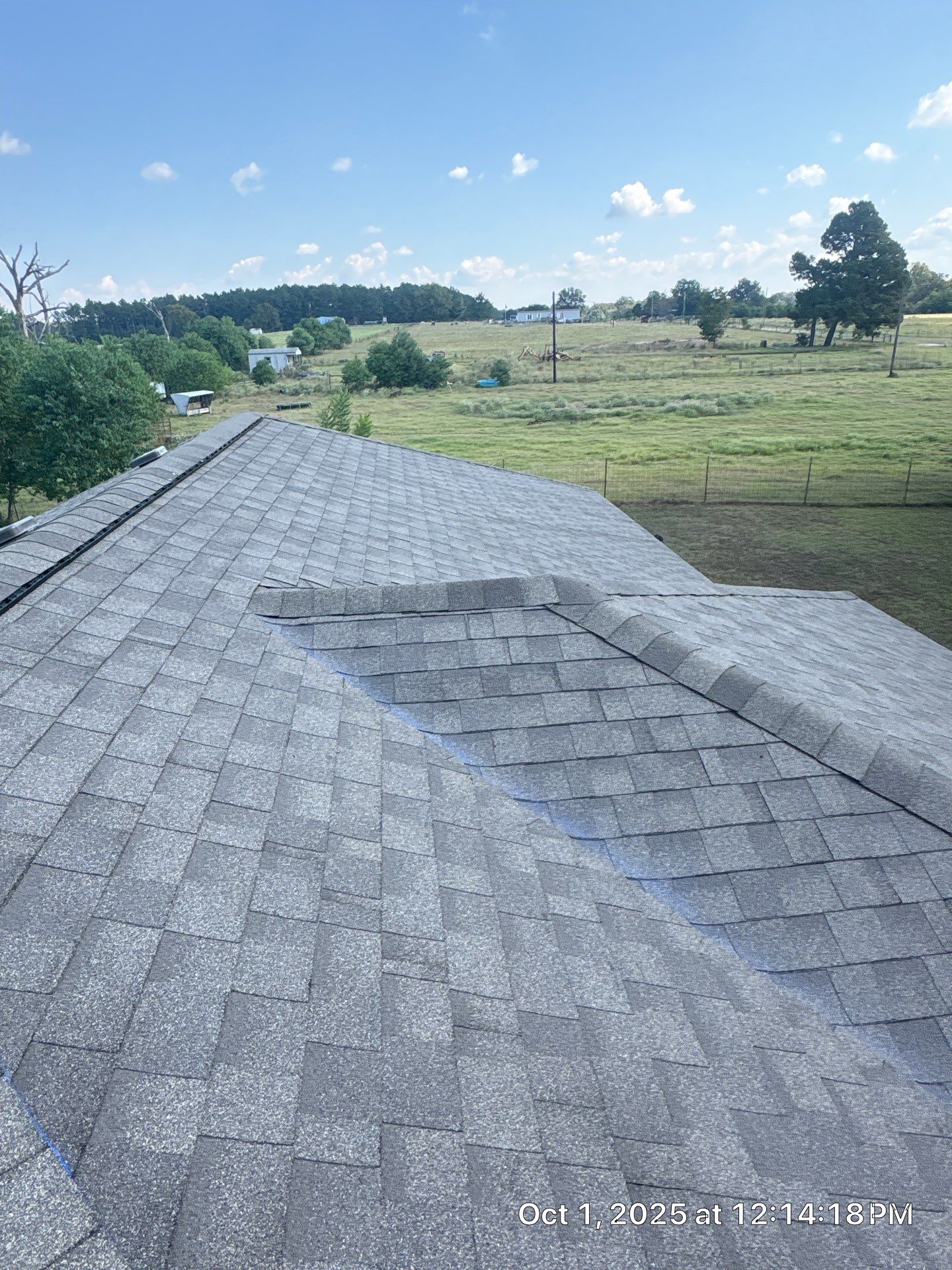
Hail is what property owners think about, but wind is what usually opens the roof, and Shenandoah roofs feel it more than most because of how they are shaped. The homes here carry complex roof lines with valleys, dormers and hip intersections stacked close together, and every one of those transitions is a seam where wind can get a purchase. Commercial buildings along David Memorial Drive and the frontage add their own version: parapet caps, coping joints, roof-mounted mechanical curbs and edge metal that peels back in sheets once a corner lets go. We check bond by hand along every edge run, lifting tabs to feel whether the seal is intact or has already released, because that is a condition you can only find by touching it.
Where the ridge cap itself is gone or shifted, the repair is straightforward and urgent, since the ridge is also where the ventilation sits and an open ridge feeds water directly into the attic. Our Shenandoah roof repair crews carry cap shingle, ridge vent and closure on the truck so an exposed ridge does not sit open waiting on a supply run.
Tarping a Building That Has to Open Tomorrow
Emergency work on the mixed residential and commercial properties along the corridor.
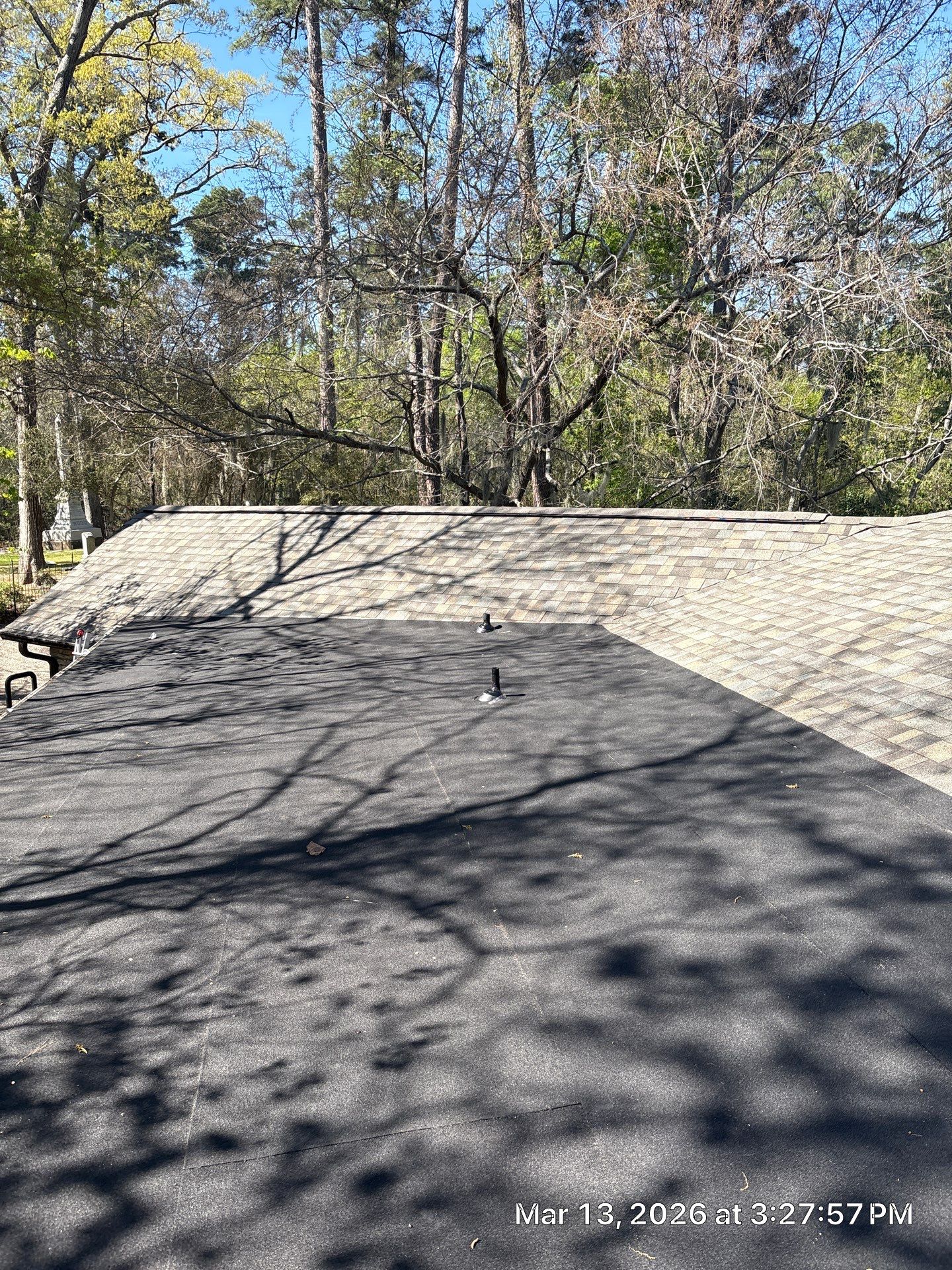
A house can absorb a bad night. A restaurant, a clinic or a retail suite off David Memorial Drive cannot, because water landing in the wrong bay closes the doors and the loss stops being about roofing very quickly. When we get an emergency call from a commercial property owner in Shenandoah, the first question is what sits under the breach: a stock room, a server closet, a dining floor, a patient area. That answer sets the order of operations before anyone unrolls anything.
The other half is scheduling. Crews can stage before opening, work in phases that keep an entrance and a parking bay usable, and hold the loudest tear-off for hours that do not sit on top of your busiest service window. Call (936) 354-3232 and tell us what your hours look like, and we will build the sequence around them.
What an Adjuster’s Scope Tends to Miss
Complex roof lines hide the details that decide whether a repair actually closes the leak.
Hip and Valley Detail
A scope written by square footage alone rarely funds the cut and weave a hip or a closed valley actually takes. On stacked roof lines those transitions carry most of the labor and most of the leak risk, so we itemize them separately and show the linear footage in the photo record.
Accessories and Penetrations
Boots, vent hoods, counterflashing, ridge vent and edge metal get replaced with the field they sit in, but they fall off a quick scope constantly. Reusing a brittle collar under new shingle is how a roof leaks in the same spot within a season.
The Packet You End Up Holding
Streamlined claims assistance means you are never the one assembling the file.
Faith Roofing Group handles the documentation, the adjuster coordination and the repair scope preparation for Shenandoah property owners, and we have worked claims with the carriers that write policies around here. What that looks like in practice is a bound record that belongs to you whether or not we ever pick up a bundle. It opens with the storm date and the address, moves through slope-by-slope photography with the test squares visible, lists the soft metal impacts, and closes with a line-item scope written the way Montgomery County adjusters read one.
If the carrier pays, you cover your deductible and we schedule the work. If the damage does not rise to a claim, we say so plainly and give you a written roof quote for the repair, which is often the cheaper road anyway. Either way the inspection costs nothing, and the file is yours to keep for the next adjuster who ever asks what this roof has been through. See the finished work in our project gallery, or read our site-wide storm damage repair overview.
Storm Response Across South Montgomery County
Two square miles of dense rooftops, reached from Huntsville straight down the interstate.
Where We Work in Shenandoah
We answer storm calls throughout Shenandoah, from the residential streets to the retail, medical and office properties along the I-45 corridor and David Memorial Drive. Because the city packs so many rooftops into a small footprint, one cell frequently touches homes and commercial buildings within the same few blocks, and we would rather run both in one trip than make you wait a week for a second visit.
Other Shenandoah work: roof installation, metal roofing, and gutter installation for the runs that hail flattens along with the shingle.
Questions After a Shenandoah Storm
Answers we give homeowners and property managers most weeks in spring.
How do you tell a hail bruise from a worn-out shingle?
A bruise is round, soft under the thumb, and shows granules pushed aside where the stone landed. Wear is even thinning across the whole slope with curled corners and splits along the seal line. Bruises also cluster with the wind on one or two faces, while wear sits on every plane at once.
Nothing looks wrong from my driveway. Is an inspection worth it?
Usually yes, because the two things that matter most are invisible from the ground. Bruising barely reads on dark shingle at any distance, and a wind-broken seal bond drops the tab right back into place looking untouched. If a cell moved through your block, a look costs nothing.
Can you tarp my commercial building without closing it?
Almost always. Tell us what sits under the breach and what your hours are, and we stage around them: cover installed before opening, entrances and parking bays kept usable, noisy work held out of your busiest window.
Why does my complex roof line change the repair scope?
Hips, valleys and dormer transitions carry far more labor per square than an open slope, and they are where leaks start. A scope built on area alone underfunds that work, so we itemize the linear footage of every transition and show it in the photo record.
Do you meet the insurance adjuster at the property?
Yes, and we ask to. Standing on the roof together at the same test square resolves in minutes what email drags out for weeks, and anything we read differently gets written down that day. There is no charge for the meeting.
What if the damage is not enough for a claim?
We tell you straight and hand you the written report anyway. Small repairs frequently cost less than the deductible, so filing would not help you. In that case you get a roof quote covering only what actually needs work.